All Around Growth — reflections on faith, freedom, and finding purpose through Orthodox Christian living, formation, and the long work of becoming. Earlier episodes available to supporters.
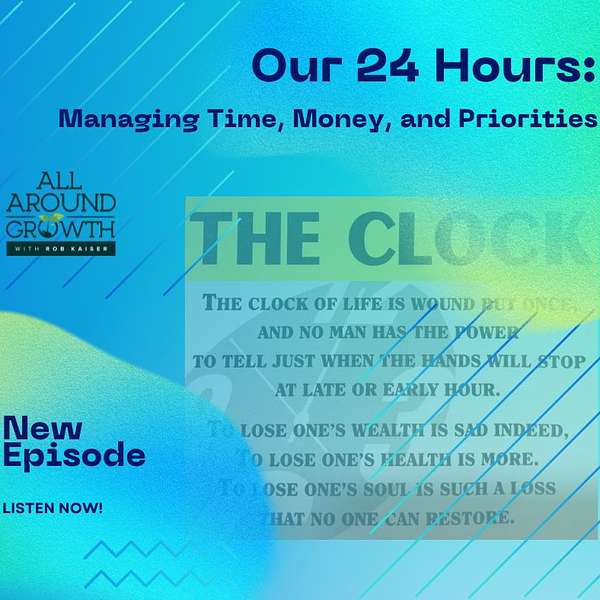
Our 24 Hours: Managing Time, Money, and Priorities - Season 5, Episode 7
•Season 5•Episode 7
Use Left/Right to seek, Home/End to jump to start or end. Hold shift to jump forward or backward.
0:00
|
34:33
Today we dive into the intricacies of time management, productivity, and personal well-being. In this insightful episode, we explore the concept of our "24 hours" and how we choose to spend them. Join us as we discuss:
Defining Time: The 24-Hour Day
Personal Perspectives on Time
Time Management and Mental Health
Buying Time: Resources and Priorities
Hustle Culture: Balancing Ambition and Well-being
Financial Perspectives: Spending and Saving
Generational Perspectives: Learning from Past Experiences
From reflections on hustle culture to generational insights, this episode offers valuable takeaways for navigating life's ever-present ticking clock. Tune in to gain fresh perspectives on managing your most precious resource: time.
Intrigued by the discussions on The All Around Growth Podcast?
Want to engage further with our community and have a say in the direction of future episodes? Consider becoming a Patreon subscriber today! Gain exclusive access to our private Telegram group, where you can interact and share in a more intimate manner with fellow listeners. As a subscriber, you'll also have the opportunity to help dictate the topics of future shows and guide the direction of the podcast according to your preferences. Join us in shaping the conversation and deepening your understanding of whatever topics YOU see fit to discuss in the future.
Subscribe now and be part of our growing community!
Well, hi there, good morning, good afternoon, or good evening, wherever you are, whatever the case may be. Welcome back to season five, episode seven of the All-Around Growth Podcast. And this episode is titled Our 24 Hours Managing Time, Money, and Priorities. In this episode, we are going to dive deep into a topic that probably hits close to home for many people as we all navigate our own 24 hours in this fast-paced world that we live in. This episode was sparked by some fantastic conversation that occurred within the Telegram group that was created specifically for Patreon subscribers. So what happened here is we had some dialogue about the topic for today's show last week in that group. And if you want to participate in that group, then join us over at patreon.com slash allaroundgrowth, and you will be provided with the link and the information in order to get into that conversation, conversations that guide and direct this episode and future episodes. So what we're going to be talking about today is just defining time. We're going to talk about the 24-hour day itself. I'm going to share some personal perspectives on time. Kind of resources and priorities and how we can do that. Talk a little bit about hustle culture, you know, balancing ambition and well-being. We will also talk about some financial perspectives, spending and saving, generational perspectives, how we've learned from past experiences, and then wrap it up with wherever this conversation takes us. So do whatever you need to do. Grab your favorite beverage, kick in your earbuds, put in your earbuds, don't kick them in, kick back, whatever. Join us as we explore the twists and turns of all of that time management, mental health, and ultimately finding the balance between chasing dreams and taking care of ourselves. So let's get into it. Like I said, the the concept of our 24 hours basically comes from the dialogue that took place last week in the Telegram group. This was a topic that was initially brought up by Wayne. Big shout out to Wayne for the topic, and big shout out to all of our Patreon subscribers, Rachel, Sean, Kiriki, you guys, and the dialogue that ensued based from Wayne's comment made to made this conversation what it is. And I very much appreciate it. So, guys, like I said, if you want to join, if you want to join the Telegram group, we've got a great community out there at t.me slash allaround growth. But if you want to get into the behind the scenes discussion and experience some deeper, more intimate discussions, then join us on Patreon, patreon.com slash allaroundgrowth, and you will get some insight into what other people do not. And it is really turning out to be a nice addition to what we are already doing on Patreon. So check it out. The technicality of that. That was something that I don't know much about. And the reality is I didn't take, I didn't put in the time, effort, and energy to learn about that. But the reality is it's probably true, and this is likely why we have this weird thing called a leap year. There was some additional dialogue about why that is, um, why the calendar year is what it is, how it could be different, and so on and so forth, but we maintain this 24-hour cycle despite the astronomical realities of the day and the cycles of time for reasons that are beyond my comprehension. And that's not surprising because there's so much in this world that is beyond my comprehension, and I'm going to elaborate on that in just a second. So, as far as personal perspectives on time, all I can really talk about is my own individual experiences and reflections on how my time is utilized. And this is an interesting perspective to share because it's changing, and that's really been the only constant in life, but at least my own life is change, and it's going to need to continue to change. Um, there needs to be some different management strategies that are implemented in my own life to ensure that I find that balance that I previously mentioned. And it's going to be a little bit challenging because of the profession that I find myself in now, which is effectively a one-man operation making products for sale at farmers market and retail locations. There is only so much that I can do as one individual, and hopefully, as time goes on and I learn the ins and outs of this business that I have absorbed from my family and from my father, I will learn just how sustainable it really is, and what I need to do to continue along this path and find balance within it. Because, in short, guys, for those of you who are listening today, February 13th, 2024, for Patreon subscribers, or for those of you who are listening publicly afterwards at some point in the future, February 20th or thereafter, um, I experienced a very uh unique and new seizure. For those who don't know, I have epilepsy, and I went to the Cleveland Clinic yesterday, February 12th, for a routine checkup with my doctor, my neurologist, and we discussed the the nature of that seizure. Uh, some some changes were made in the current management strategies of it, with which largely involve medication, anti-seizure medication, which I don't particularly like taking, but it seems to be the most effective way that I can manage this chronic neurological condition that I have. Um, I'm certainly not complaining. There are people who are in situations with neurological conditions like mine and others that are in situations far worse than me, and I'm grateful that what I have is what it is because I do understand that it could be far worse, and I'm grateful that I'm able to do what I do the way that I do it, but the reality is I need to learn how to more effectively manage stress in life, stress that comes from all aspects of life, and I also need to very much prioritize my responsibilities so that I am able to get the sleep that I need to get. And the unfortunate the reality, it's not unfortunate. The reality is that I need to get quality sleep in a quantity that I kind of wish that I didn't have require. Um I don't function optimally if I routinely sleep less than eight to nine hours a night. I know many people who are able to and have functioned on four hours of sleep and have done so for years. Um I would love that. But you know, based on the appointment and dialogue that I had yesterday with the doctor, and the fact that I have to go back for another EEG and some additional blood work, is evident that I'm I I can I need to continue to make some changes. Um for those of you who don't know what an EEG is, it is an electroencephalogram, if I'm not mistaken, and um it is used to evaluate brain disorders. Um so an EEG is a test that helps detect abnormalities in your brain waves or within the electrical activity of your brain within that electric meat. Okay, so during that procedure, electrodes consisting of small metal disks with thin wires are pasted onto your scalp, and those electrodes are able to detect tiny electrical changes that result from the activity of one's brain cells. These charges are amplified and appear as a graph on a computer screen or as a recording that may be printed out on paper. And once that is done, the doctor, healthcare provider, the person that reads that chart or graph, then interprets the reading and just performs an evaluation on it and will likely compare it to past EEGs that I have had in the past. Um yeah, so I've I've I've got to have another one of those done because I have had more seizures lately over the past few months, and the nature of the seizures is changing. So I need to focus a little bit more on what I'm doing, how I'm doing it, and ultimately keep in mind activities that contribute to my overall mental well-being. So I may not simply be able to grind it out all the time. I need to make sure I'm engaging in self-care and quite frankly, some recreational or leisurely activities that contribute to my increased mental health. Some of which I am learning is taking time in the morning to read, study, meditate, and just put myself in a good spot mentally for the day ahead. And that time to prepare myself for the day is increasing. And that's okay, and a lot of that time that I spend in the mornings is spent in prayer, reading, and meditation, and just increasing the depth of my spiritual life so that I can understand not only what I'm doing, but why I'm doing what I'm doing. And as time goes on, if the business continues to grow and I'm able to manage that growth in a good way, my financial resources will improve. And once that happens, I will be able to more effectively manage my time. And herein comes the concept of buying back time through you know outsourcing certain tasks that need to be done or delegating certain tasks that need to be done, and a lot of people do this, for example, by hiring other people to do certain things. There are people out there who, for example, make a living cleaning houses and doing certain tasks around the home of someone who is more engaged in their career, making more money so that they are able to hire other people to clean the kitchen, clean the bathroom, clean whatever, you know, help cook meals, even do certain things like change light bulbs and engage in activities that were most people, like you and I, are normal routine activities that we do as uh homeowners and and and uh renters and just people living a big air quotes normal life. But there are other people who are more than willing to pay others to do these things so that they can focus their time, effort, and energy on whatever it is that they are focusing their time, effort, and energy on. So that is one way that one could go about buying back time through, like I said, outsourcing and and delegation of work or tasks that need to be done. Like I said, uh previously I talked about you know balancing the the hustle and grind with personal well-being, and and this is a little bit challenging because there's been a lot of talk, and this is nothing new really, but there's there for as long as we have been consuming content, you and I, at the age that we are, we've we've spent some time consuming content on you know the go-getters, people who are doing the thing, right? And whether that's homesteading, you know, personal finance, entrepreneurship, um, you know, motivation and and and physical wellness, or you know, whatever the case may be, we are listening to and and consuming content, watching videos of people who speak about the hustle, the grind, and there's a big focus on this hustle culture. And I am reaching a point, and we talked about this in the Patreon supporter telegram group, that this idea of hustle culture can at times have a negative impact on our personal life, and if we let it, it can have a negative impact on our professional lives as well. If too much hustle is spent on our professional lives, it can have an impact on our personal life, our family, our spiritual life, so on and so forth. If there's too much hustle put on other aspects of life, it may have an impact on our professional life. And that's kind of where I'm at right now, realizing that perhaps I need personally, me, to put more time, effort, and energy, more hustle, if you will, on varying aspects of my life outside of my professional life. More time, effort, and energy, more focus on my personal life, my physical well-being, my spiritual life. And I need to continue doing things a little bit differently so that I can find balance between ambition, productivity, and the maintenance of my own mental health. Because when I don't do that, things happen. Everything that we do has a consequence of some kind. Positive consequences, negative consequences, whatever the case may be. And I have experienced some negative consequences from the hustle culture, and and I've lost some of the balance that I so frequently speak about on this show. And accordingly, I'm going to try to find that balance. And the unfortunate reality is that in order to do so, I may have to find myself saying no from time to time. There may be certain aspects of life, whether those are financial aspects, social engagements and commitments, things with family, or even in my spiritual life, I may have to say no at any given point in time in order to focus on something elsewhere. And some of those things, like I said, that I may have to say no to are with regard to finances. Because of the way I've chosen to live my life. I really need to dive deeper into my spending habits. And I need to analyze that a little bit more to understand the impact of the decisions that I make and the actions that I take and how it will affect my financial stability in the long run. You know, the classic example is Starbucks. You know, if we are running around running errands on our commute to work, whatever the case may be, if we are constantly buying that latte from Starbucks for however much a latte from Starbucks, let's just say $6 for a Venti latte, um, and we're doing that on the daily, you know, that's $40 a week. $40 a week times you know, 52 weeks a year is a lot of money. Um, you do the math. So this is kind of you know, do we need that Starbucks latte, or are we in a position where we can simply make something that is comparable and gives us that satisfaction of the latte at home in a nice Contigo travel mug. That's that's that's the one that I use. Um maybe it's not as good, maybe it it it it doesn't give us the the the pleasure that we get from that that transactional operation of of Starbucks, but maybe it helps us cut back on certain things so that we can have other things. Whatever those other things are. I I don't know. And you know, this is something that I used to do. Uh there was a point in time where part of my daily commute involved stopping at Dunkin' Donuts, for example, and I would get a an iced coffee and a breakfast sandwich, and I would do that every day. And at the same time, I was struggling to I wasn't struggling yet, but I was acknowledging and understanding the fact that oh, I have all this debt, you know, maintaining this lifestyle of debt and consumerism is not sustainable for you know Mr. Wannabe permaculture and sustainability, and I had to make some changes. I had to stop doing that. I had to stop doing a lot of things that I was doing in order to get out of debt, save some money, and position myself to where I could quit my job. I needed to to you know to to not take that vacation, to not buy the new pair of car hearts that I wanted to not do a lot of things that I that I wanted to do, uh, to not go certain places and do certain things with certain people because at that time those things, places that I was doing with people required some some money. And I needed to refocus, and the way that I was able to refocus was through implementing a lifestyle that was largely centered around the principles outlined in Financial Peace University, following the baby steps, and changing my life so that I could actually change my life. And that's that's kind of the whole point that Dave Ramsey talks about with Financial Peace University. And I'm I'm I'm drawing a blank because I'm I'm pausing because I'm drawing a blank, focusing on trying to remember the saying that he used to say, living like no one that's it. Excuse me, living like no one else, so that later we can live and give like no one else. And that's a key point that I think a lot of people forget is that in order to receive, we must give, we must tithe, we must give before we spend. And that's not something that I did for a while, and I continued to struggle with my own journey to get out of debt, and I'm not saying this so that you guys out there listening can say, Oh wow, Rob's such a good guy. He he he he tithes, he he gives to charity. That's that's not it at all. I'm just simply sharing some some stories and insights from my own experiences in the past and saying that the old sayings are true. We must give to receive. And I don't know if this is a if this is a generational thing or what. I I I I really think it's just human nature, but so often we get caught up in in our own problems and our own oftentimes of our own making, that you know we we we find ourselves challenged with finding a solution, but really what we need to do is take a good hard look at our own personal approach to work, money, and lifestyle. And pretty much in short, what it comes down to is if there's certain aspects of uh if there's a certain lifestyle that we want, then we need to change our approach to how we manage our work and our money if we want to change the way in which we manage our life. And the reality is making those changes is hard, and most people aren't willing to do the work that it takes. And this is why so many people get stuck in the rut that they're in and they stay there because they're not willing to make that difficult change. Right? So again, if nothing changes, nothing changes. But if you want to change, then that's what you've got to do. So to conclude this this this talk of this show, our 24 hours managing time, money, and priorities, I know that we talked about a lot. We also talked about nothing in particular, but it really comes down to our perspective on the twenty-four-hour day, understanding that our life is comprised of these days, and really understanding that our life as it is is only today. We don't know what's going to happen at any given point in time. We don't know how much time we have left. So, really, at the end of the day, we need to make the most of this day right here, right now, so that when our time comes, we can go in peace. Understanding that routinely and consistently we did the best we could do consistently, and hopefully, when we do that, we set a good example for others to do the same because we make things far more complicated than they need to be in this life, and doing all of these things and living differently, it's really quite simple, but it's not easy. So, I would just encourage you guys out there to reflect on your own time management strategies, your own priorities, and focus on the life that you want to live and ultimately begin living it. So, guys, that's it for today. I hope that you have a great week ahead. I really appreciate you listening, and I look forward to catching you next week. This is Rob Kaiser. Thank you and God bless.
Podcasts we love
Check out these other fine podcasts recommended by us, not an algorithm.